PhD to Industry Cover Letter Example: A Research Scientist Application
7 min read · Published 2026-08-07
The PhD-to-industry transition has a classic failure mode: the cover letter reads like an abstract. Hiring managers in industry want to know one thing — can this person produce outcomes, not just knowledge? This worked example shows how a plant-genomics PhD makes the case, with the real CoverForge deliverables.
Meet the applicant
Fictional example persona
Dr. Henrik Sørensen
Career changer · PhD plant genomics (defense Oct 2026) → industry · Copenhagen
- Six peer-reviewed publications, an R pipeline adopted by two other research groups, four MSc students supervised
- Secret weapon: a four-month industry placement at a seed company — he already knows how lab work survives contact with field trials
- Goal: prove "academic" and "applied" aren't opposites on his resume
The job posting he found
Fictional job posting
Research Scientist, Plant Genomics — Verdant Biosciences (Copenhagen)
Verdant Biosciences develops drought-tolerant crop varieties for a changing climate. We seek a Research Scientist to lead trait-discovery projects.
What you'll do:
- Design and execute genomics experiments (GWAS, marker development) linked to drought-tolerance traits
- Analyze sequencing data; communicate to scientific and commercial colleagues
- Author reports; contribute to patents and publications; supervise one technician
What we're looking for: PhD in plant genomics or related · strong publications relative to career stage · R/Python bioinformatics · a genuine interest in applied outcomes — our success metric is varieties in the field, not citations. Industry experience welcome but not required.
That success-metric sentence is the whole game. It's a direct invitation to address the academic-vs-applied question head-on — and Henrik is unusually well equipped to answer it.
The inputs
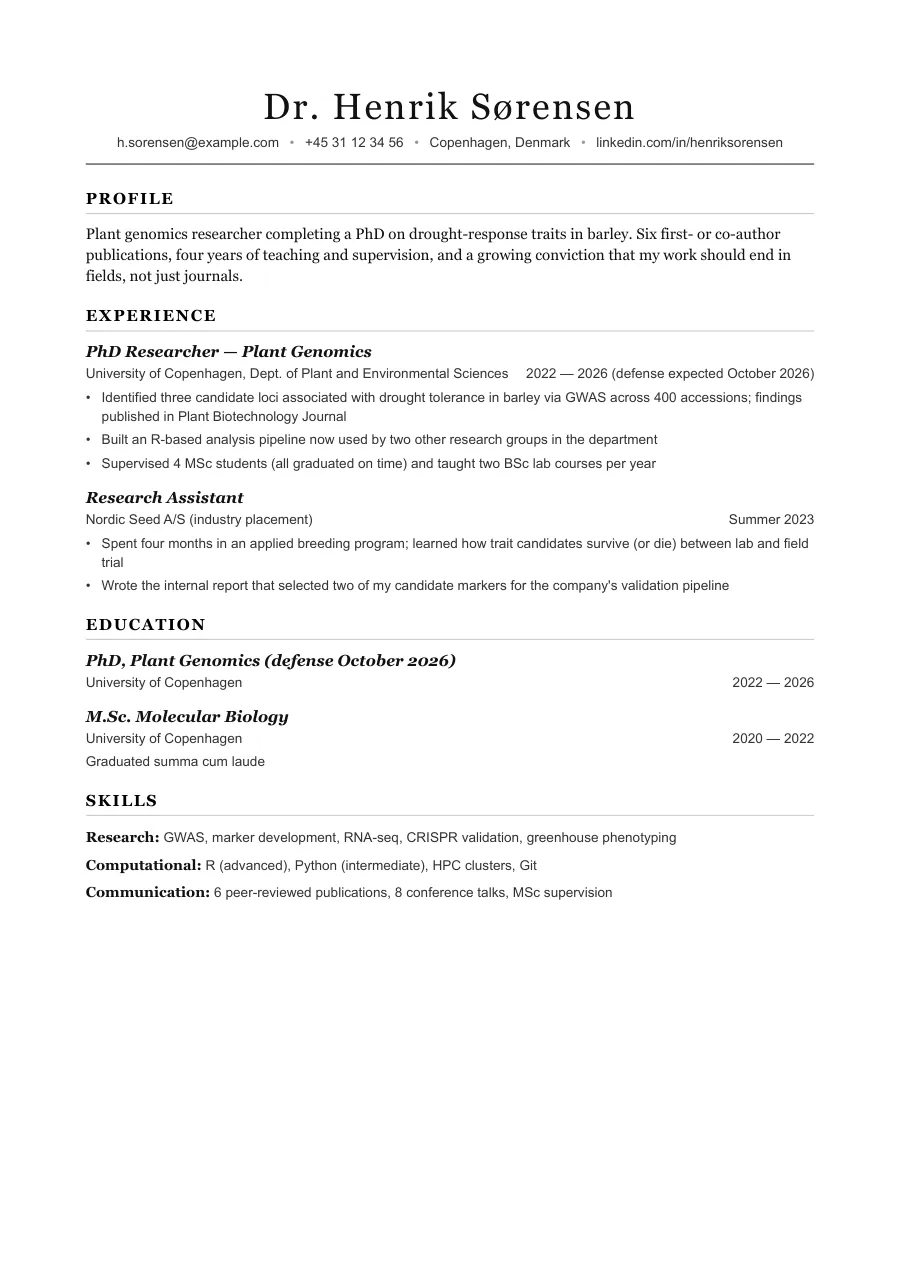
Resume data — input
Dr. Henrik Sørensen — Copenhagen · PhD Plant Genomics (Univ. of Copenhagen, defense Oct 2026) · M.Sc. Molecular Biology, summa cum laude
PhD Researcher, 2022–2026: identified 3 drought-tolerance candidate loci via GWAS across 400 barley accessions (published in Plant Biotechnology Journal) · built an R pipeline adopted by 2 other groups · supervised 4 MSc students, taught 2 lab courses/year
Industry placement, Nordic Seed A/S, summer 2023: 4 months in an applied breeding program · internal report led to 2 candidate markers selected for commercial validation
Skills: GWAS, marker development, RNA-seq, greenhouse phenotyping · R advanced, Python intermediate · 6 publications, 8 conference talks
Tone selected: Formal (scientific hiring, especially in established companies, still rewards formality — see the tone guide). PDF theme: Classic.
The deliverables
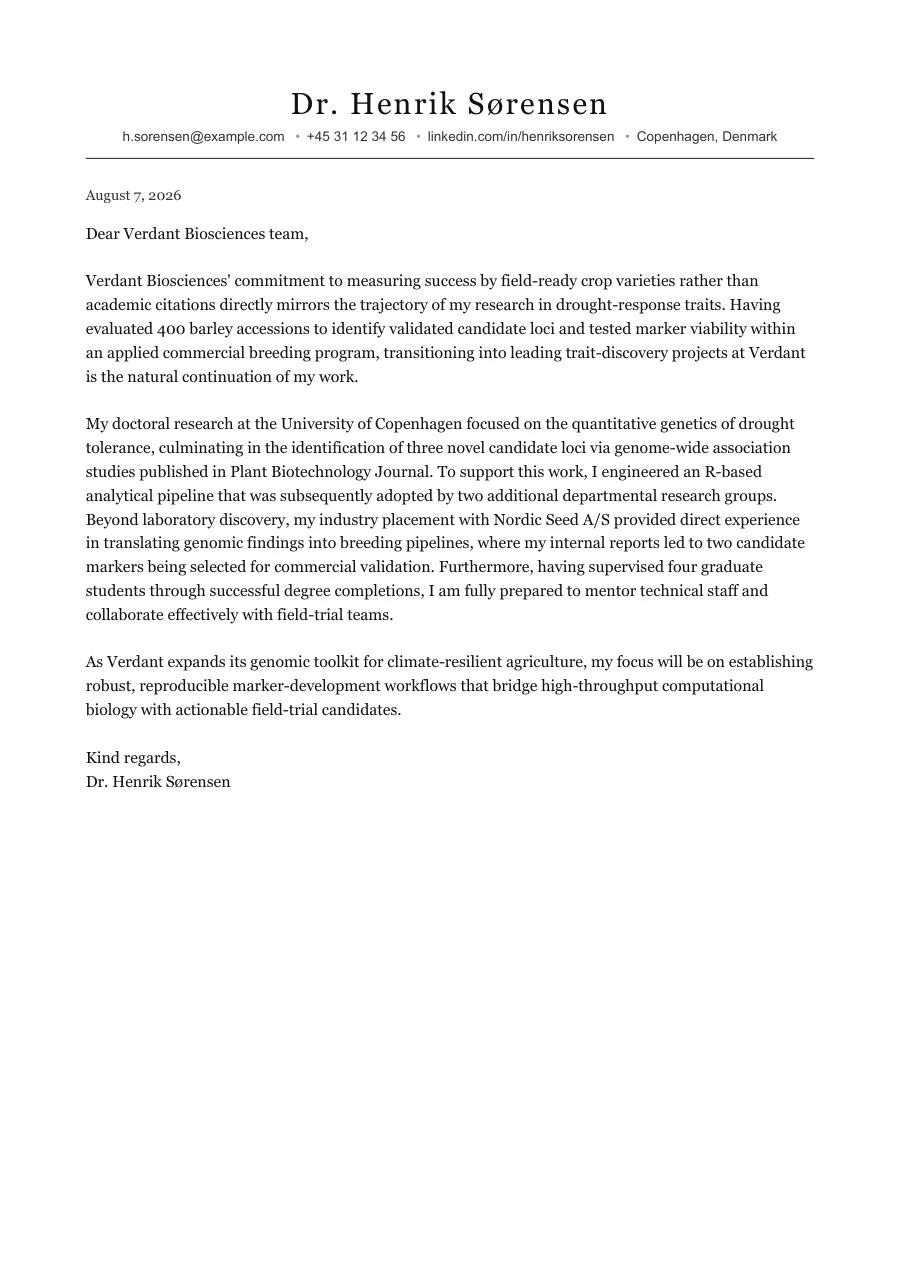
Cover letter — generated by CoverForge (Formal tone), lightly edited
Dear Verdant Biosciences team,
Verdant Biosciences' commitment to measuring success by field-ready crop varieties rather than academic citations directly mirrors the trajectory of my research in drought-response traits. Having evaluated 400 barley accessions to identify validated candidate loci and tested marker viability within an applied commercial breeding program, transitioning into leading trait-discovery projects at Verdant is the natural continuation of my work.
My doctoral research at the University of Copenhagen focused on the quantitative genetics of drought tolerance, culminating in the identification of three novel candidate loci via genome-wide association studies published in Plant Biotechnology Journal. To support this work, I engineered an R-based analytical pipeline that was subsequently adopted by two additional departmental research groups. Beyond laboratory discovery, my industry placement with Nordic Seed A/S provided direct experience in translating genomic findings into breeding pipelines, where my internal reports led to two candidate markers being selected for commercial validation. Furthermore, having supervised four graduate students through successful degree completions, I am fully prepared to mentor technical staff and collaborate effectively with field-trial teams.
As Verdant expands its genomic toolkit for climate-resilient agriculture, my focus will be on establishing robust, reproducible marker-development workflows that bridge high-throughput computational biology with actionable field-trial candidates.
Kind regards,
Dr. Henrik Sørensen
Why this letter works
- It answers the unspoken objection first. The posting's "varieties, not citations" line is mirrored in the opening sentence — and immediately backed by the industry placement. The "too academic" worry never gets oxygen.
- Academic achievements are translated into industry currency. A publication becomes "three validated candidate loci"; a teaching load becomes "prepared to mentor technical staff." Same facts, employer's vocabulary (see the career-change example).
- Every posting duty has a matching proof. GWAS ✓, marker development ✓, cross-audience communication ✓, supervision ✓ — mapped one-to-one, evidence first.
- The close is about their pipeline. "Bridge computational biology with field-trial candidates" speaks directly to the company's lab-to-field identity.
Make it yours — don't copy this
Your field differs, but the move is the same: name the industry's success metric and show one piece of evidence you already think that way. Paste the posting you're considering — a minute, no account needed.
Related
- Career change worked example
- How to tailor a cover letter to a job posting
- Do cover letters still matter in 2026?
Try it on a real job posting
Paste any job ad and get a tailored cover letter draft in about a minute — no account needed to try. Free during early access.
Generate my cover letter →Persona, company, and job posting on this page are fictional examples. The cover letter and PDFs were genuinely produced by CoverForge and lightly edited for clarity.